Colloquium
The INTEGRATE Colloquium will provide trainers and trainees the opportunity to engage other UW–Madison faculty working in relevant areas and invited external “keynote” speakers who are leaders in research at the intersection of robotics, work, and society. The wide range of topics are intentional to enrich trainee perspectives, backgrounds, and experiences. Participants will be encouraged to engage in follow-up discussion, networking, and socializing and thus serve as a catalyst for communication and community building.
If you would be interested in giving a talk, please contact Kristie Schultz.


Upcoming Talks
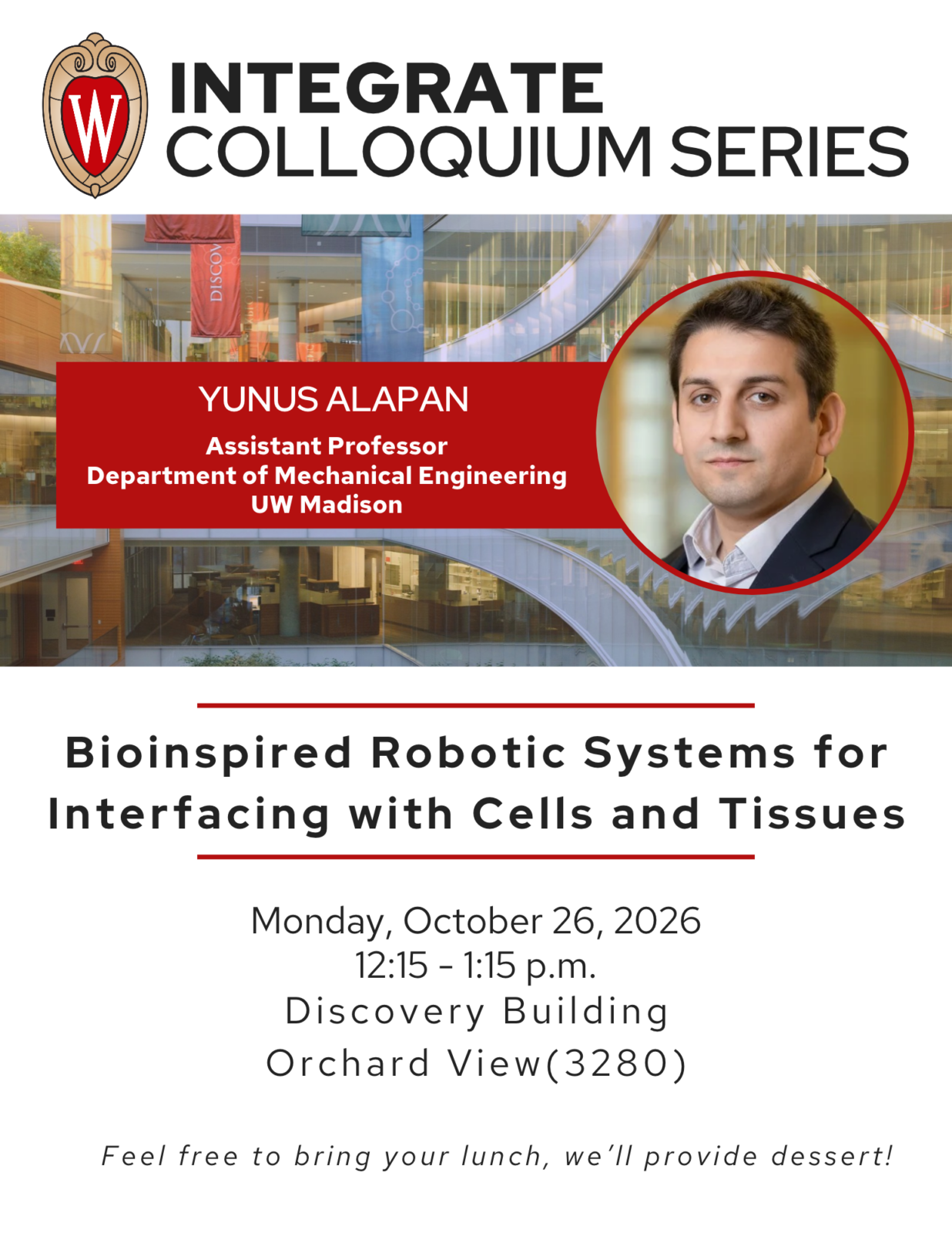
October 26, 2026: Yunus Alapan, Assistant Professor, Mechanical Engineering, UW–Madison
Zoom Link
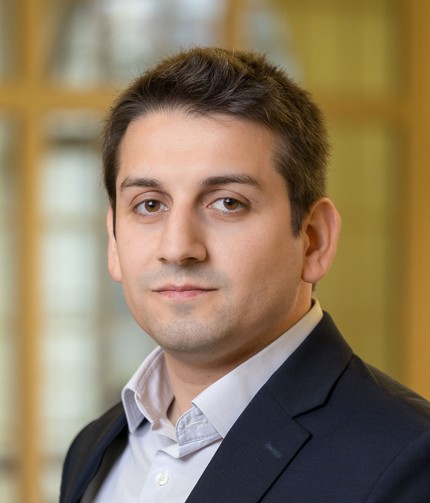
Yunus Alapan
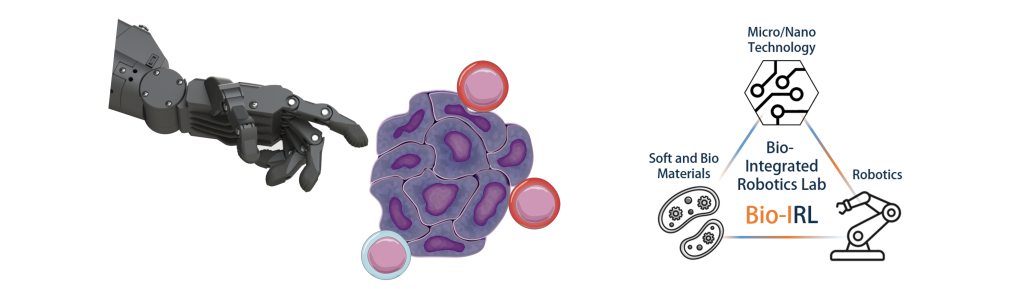
Yunus Alapan is an Assistant Professor of Mechanical Engineering at the University of Wisconsin–Madison, where he directs the Bio-Integrated Robotics Laboratory (Bio-IRL). His research bridges robotics, microtechnology, and bioengineering to develop bio-inspired soft micro-robots for healthcare applications. He earned his Ph.D. in Mechanical Engineering from Case Western Reserve University and completed postdoctoral fellowships at the Max Planck Institute for Intelligent Systems and Georgia Tech. Dr. Alapan has authored more than 50 articles and proceedings in top-tier journals and conferences, including Nature Materials, Science Robotics, Nature Communications, ICRA, and IROS. His research at UW–Madison has been supported by the NSF and DARPA. Dr. Alapan is the recipient of numerous professional honors, most recently including the Best Application Paper Award at MARSS 2025, alongside the Humboldt Postdoctoral Fellowship, and first-place prizes in the CIMIT Primary Healthcare competition and NASA’s Create the Future Design Contest.
Bioinspired Robotic Systems for Interfacing with Cells and Tissues
Abstract coming soon
Archived Talks
- October 5, 2026 – Robotics to Rebuild, Study, and Rehabilitate Humans, Peter Adamczyk, Associate Professor of Mechanical Engineering at UW–Madison
- April 10, 2026 – Toward Flexible & Effective Human-Robot Teaming, Mike Hagenow, Assistant Professor of Computer Sciences at UW–Madison
- March 4, 2026 – From Muscles to Metabolism: Rethinking Energy, Actuation, and Intelligence in Robots James Pikul, Associate Professor of Mechanical Engineering at UW–Madison
- December 3, 2025 – The Race between Academia and Industry for AI Researchers Alice Wu, Assistant Professor of Economics at UW–Madison
- November 7, 2025 – Robot Learning and Wearable Interfaces in Pursuit of Robotic Caregivers Zackory Erickson, Assistant Professor, Robotics Institute, Carnegie Mellon University
- March 5, 2025 – Robots and Inequality: Between and Within Occupations Rodimiro Rodrigo, Assistant Professor of International Business and Economics at the George Washington University School of Business (GWSB).
- February 26, 2025 – Rethinking Design for Human-Robot Collaboration. EunJeong Cheon, Assistant Professor in the School of Information Studies and Senior Research Associate at the Autonomous Systems Policy Institute (ASPI) at Syracuse University. Zoom recording available, integrate-nrt@wisc.edu.
- November 6, 2024 – Automation and Labor: The Role of Robots Hee Rin Lee, Assistant Professor in the Department of Media and Information at Michigan State University.
- October 2, 2024 – Mapping the Mind: Neuroergonomics Insights into Human-Machine Interaction. Ranjana Mehta, Grainger Institute of Engineering Professor in the Department of Industrial and Systems Engineering at the University of Wisconsin Madison.
- April 17, 2024 – Economics of Automation, Robots, Competition, and Jobs. Victor Bennett, Professor of Entrepreneurship and Strategy at the University of Utah’s Eccles School of Business.
- February 28, 2024 – Blending Reality: The Real-World Impact of XR Technologies Kevin Ponto, Associate Professor at WID and in the Design Studies Department in the School of Human Ecology at UW–Madison.
- November 8, 2023 – The Second Robot Problem: Obstacles to Manufacturing Automation at Scale. Ben Armstrong, Executive Director, MIT Industrial Performance Center.
- September 27, 2023 – Copyright’s Latent Space: From Fair Use to Generative Art BJ Ard, Law School, University of Wisconsin–Madison
- April 28, 2023 – First Wisconsin Robotics Symposium A collaboration between UW–Madison robotics faculty, grad students and industry.
- April 19, 2023 – Enhancing Safety and Efficiency in Human-Robot Collaboration for Future Manufacturing Workspaces Dr. Marvin Cheng, Assistant Coordinator, Center for Occupational Robotics Research (CORR), NIOSH
- March 22, 2023 – Exoskeleton-Enabled Future of Work in Construction, Zhenhua Zhu, Ph.D., P.Eng., Department of Civil and Environmental Engineering, University of Wisconsin – Madison.